
If you’ve had back pain for any length of time, chances are someone has told you:
“You need to strengthen your core.”
Maybe you’ve taken that advice seriously. You’ve done sit-ups, planks, crunches, bird dogs, or other “core” exercises—faithfully and consistently.
And yet… your back pain is still there.
So what’s going on? Why isn’t core strengthening working?
Below, I want to explain why core exercises alone are often not enough—and in some cases can even be making your pain worse—and what needs to happen first if you want real, lasting relief.
Reason #1: Most back pain has nothing to do with core weakness
This surprises many people, but there is no good evidence that people with weaker cores are more likely to have back pain.
When researchers compare people with back pain to those without it, they don’t consistently find meaningful differences in core strength. In other words, plenty of people with strong cores still have back pain—and plenty of people with relatively weak cores don’t.
So if your back pain hasn’t improved despite strengthening exercises, it may be because weakness was never the real issue to begin with.
Reason #2: More strength isn’t always better
In some cases, increasing core strength can actually increase stress on sensitive spinal tissues.
Think of it like tightening the guy wires on a damaged mast. If the structure underneath is already irritated, adding more tension can increase strain rather than relieve it.
If your spine is already sensitive, excessively bracing or overworking the muscles around it can amplify compressive forces and make symptoms worse—not better.
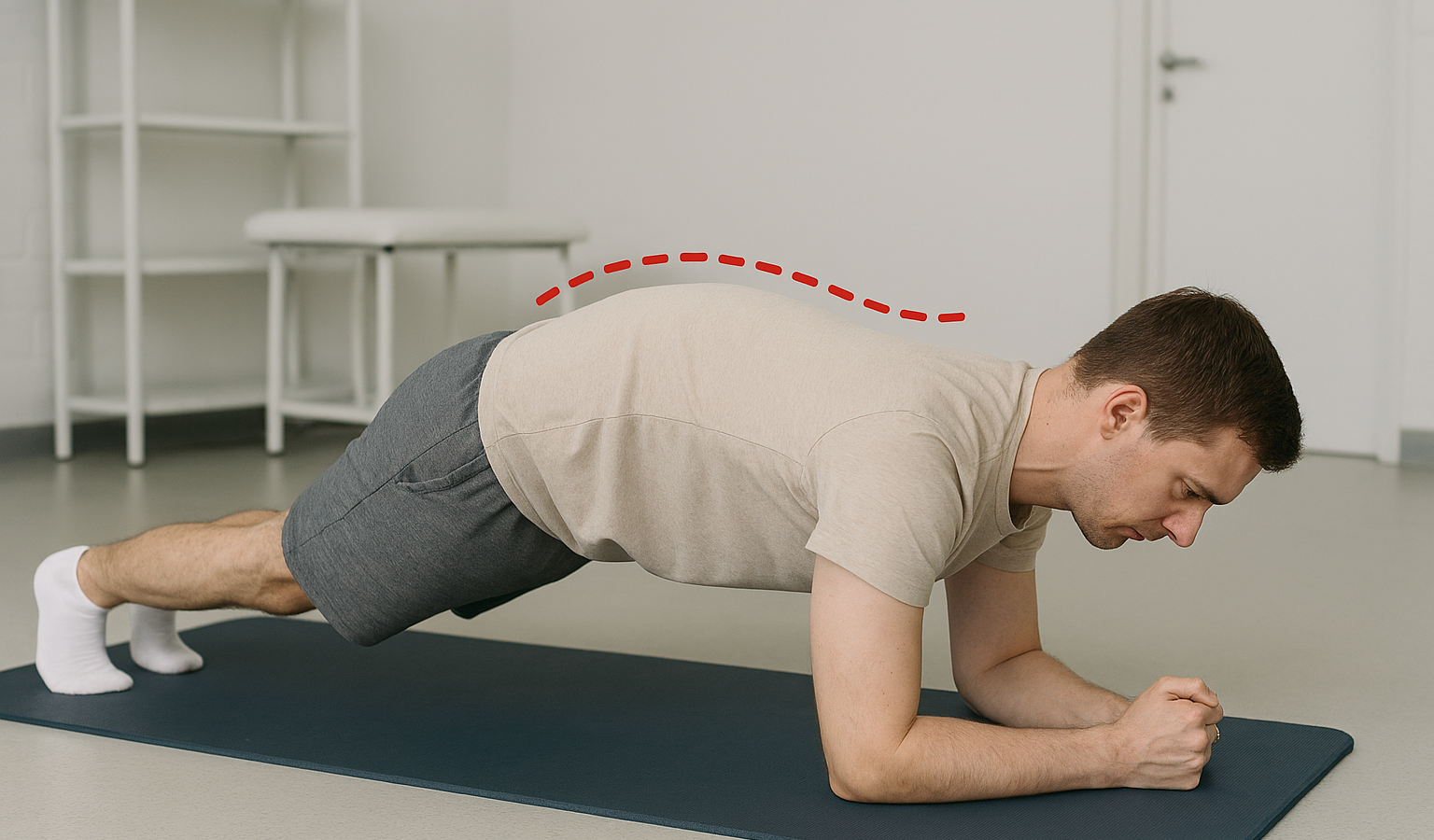
Reason #3: Many people unknowingly do “core exercises” in a pain-provoking way
This is something I see all the time.
When patients show me how they’re performing their exercises, it often becomes obvious why those exercises aren’t helping. They’re unintentionally:
- Bending or twisting into their pain trigger
- Losing spinal control as fatigue sets in
- Repeating the very movement that irritates their back
This keeps the spine sensitive rather than allowing it to calm down.
The real reason most people develop chronic back pain
Most chronic back pain isn’t caused by weakness—it’s caused by repeated overload of sensitive spinal tissues.
Daily postures and movement habits slowly and repeatedly stress an irritated part of the spine. The result is similar to:
- Picking a scab over and over
- Stubbing the same toe every day
No matter how strong you make the surrounding muscles, the irritation never settles if the trigger keeps being applied.
What actually needs to happen first
To overcome back pain, the first priority is to identify your specific pain triggers—the movements, postures, or loads that irritate your spine.
Once those triggers are identified, they must be deliberately removed or modified. This is what we call good spinal hygiene:
- Using your spine in spine-safe ways
- Avoiding known triggers
- Keeping the spine in positions it can tolerate
Only once the spine is no longer being constantly irritated does it make sense to layer in strengthening exercises.
Where core exercises do fit in
Core exercises absolutely have a role—but only when:
- The pain trigger has been clearly identified
- The trigger has been removed from daily life
- The exercises are performed in a spine-sparing way
- The goal is sufficient endurance and control, not excessive strength
When done properly and at the right time, core exercises help the spine tolerate daily demands—not fight against them.
A final thought
If you’re still struggling with back pain despite diligently performing core exercises, I’d suggest pressing pause on them for now.
Instead, focus first on identifying what is irritating your back and eliminating those triggers. Once that foundation is in place, strengthening can finally do what it’s supposed to do—support a resilient, pain-free spine.
If you’d like guidance through this process, as a McGill Method practitioner I would be happy to help you identify your triggers, clean up your spinal hygiene, and rebuild capacity safely and effectively.