
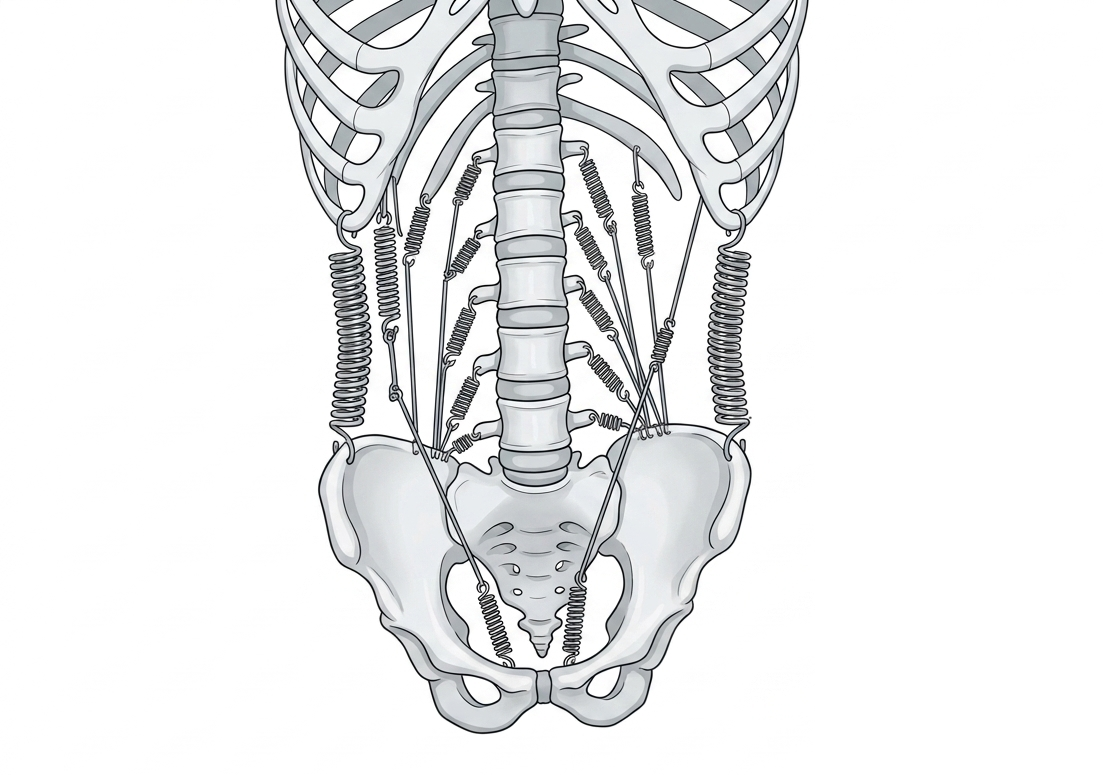
Many people mistakenly think of their “core” as just their abdominal muscles, but that is an incomplete picture.
Your “core” actually refers to the muscles located between your lower rib cage and your pelvis. It includes muscles that are located on all the sides of your torso: the front, the back and the sides. This includes:
- the front abdominal muscles (like the rectus abdominis, often called the “six-pack”),
- the side abdominal muscles (the obliques),
- the muscles along your back (including the quadratus lumborum and longissimus).
There is some academic debate regarding exactly which muscles belong to the core, but the precise list is not the most important takeaway. What matters most is realizing that your core is much more than just your abs.
Why It Matters That Your Core Is More Than Just Your Abs
One of the primary functions of the core is to act like a system of guys wires to stabilize the spine, similar to how guy wires stabilize a cell tower and keep it upright.
If you think of your core only as your abdominals, it is like only focusing on the guy wires on just one side of a cell tower while ignoring the other three. If that tower started to fall, addressing only one side likely would not fix the problem.
The same principle applies to your body.
If you focus only on strengthening your abdominal muscles while neglecting the muscles on your sides and back, you likely will not improve your spinal stability. Instead, you may even create a situation that leads to more discomfort or injury.
Why Your Core Matters
According to Dr. Stuart McGill, there are at least three critical roles that your core plays:
1. Your spine depends on your core for stability
On its own, the spinal column easily buckles. In fact, without muscular support, it can buckle under as little as 4.5 pounds of load.
Your core muscles are what provide the stiffness and support needed to stabilize your spine, allowing it to safely handle much greater weight. In some cases, trained individuals can support over 1,000 pounds because of proper muscular stabilization.
2. Movement requires a stable base
For your arms and legs to move effectively, they need a stable foundation.
A sufficiently strong core provides that foundation, allowing your limbs to move efficiently.
Without sufficient core stability, movements of your arms or legs can cause unwanted bending or twisting in your spine. This not only reduces efficiency but can also increase the risk of injury
3. Your core helps protect your spine after injury
After an injury, the spine often loses some of its natural stiffness. This makes it more vulnerable to painful or excessive movement during everyday activities.
Your core muscles can compensate for this loss. When properly activated, they provide the additional stability your spine needs, helping reduce the risk of further injury and allowing you to move more safely.
Bringing It All Together
Now you understand that your core is more than just your abdominal muscles—and why that matters.
You also know that your core plays a critical role in:
- stabilizing your spine,
- supporting efficient movement,
- protecting your spine from injury.
But this knowledge only becomes valuable when you apply it.
Start incorporating appropriate core exercises into your routine. A great place to begin for most people is with the “McGill Big 3”:
- Bird dog,
- Side plank,
- Modified curl-up
When performed at the right level of difficulty, these exercises can help build a strong and resilient core.
Your back and body will thank you.